Businesses in California have many ways to reach customers online, but two of the most commonly used digital marketing strategies are Search Engine Optimisation (SEO) and Pay-Per-Click (PPC) advertising. Both can help businesses reach people through search engines, but they work in different ways and require different approaches to planning, budgeting, and measurement.
SEO focuses on improving a website’s organic visibility in search engine results. PPC, on the other hand, allows businesses to pay for advertising placements and reach users based on selected keywords, locations, audiences, and campaign settings.
For a business operating in California, choosing between SEO and PPC depends on several factors, including business objectives, competition, target audience, geographic market, available budget, website condition, and how quickly the business needs to generate traffic or leads.
A professional Digital Marketing Agency in California can help businesses evaluate both strategies and determine how SEO, PPC, or a combination of the two can fit into their broader digital marketing plan.
What Is SEO?
Search Engine Optimisation is the process of improving a website so that its pages can become more visible in organic search results.
SEO can involve:
- Keyword research
- Search intent analysis
- On-page optimisation
- Technical SEO
- Content creation
- Internal linking
- Local SEO
- Website performance
- Structured data
- Authority building
Unlike paid advertising, businesses do not pay a search engine for every organic click generated through SEO. However, SEO requires ongoing work. Businesses may need to improve existing content, create new pages, resolve technical issues, strengthen internal linking, and monitor search performance. The time required to see meaningful results can vary depending on competition, website condition, content quality, search demand, authority, and the scope of optimisation.

Grow Your Business with Local SEO That Delivers Results
Improve your Google rankings, optimize your Google Business Profile,
attract more local customers, and generate high-quality leads with
Xtrim Digitech's proven digital marketing strategies.
Grow Your Business with Local SEO That Delivers Results
Improve your Google rankings, optimize your Google Business Profile, attract more local customers, and generate high-quality leads with Xtrim Digitech's proven digital marketing strategies.
What Is PPC?
Pay-Per-Click advertising allows businesses to pay for advertisements that can appear when users search for relevant products or services or interact with other advertising platforms. Google Ads is one of the most commonly used PPC platforms.
PPC campaigns can target factors such as:
- Keywords
- Geographic locations
- Audiences
- Devices
- Search behaviour
- Demographics
- Remarketing audiences
Businesses generally pay when users interact with their advertisements according to the campaign’s bidding model. PPC can provide businesses with greater control over where and when advertisements appear, although campaign performance depends on factors such as targeting, competition, ad quality, landing pages, budget, and conversion tracking.
SEO vs PPC: Understanding the Main Difference
The primary difference between SEO and PPC is how businesses obtain search visibility. SEO focuses on earning organic visibility through website quality, useful content, technical optimisation, relevance, and other search-related factors. PPC uses paid advertising placements to reach users according to campaign settings and bidding.
A simplified comparison looks like this:
Neither strategy works exactly the same way for every business.
How SEO Can Help California Businesses – Digital Marketing Agency in California
SEO can help businesses build organic visibility for searches related to their products, services, locations, and industry.
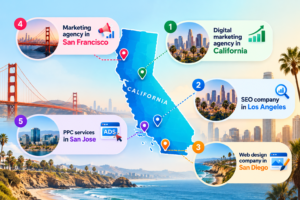
For example, a California business may target searches such as:
- Digital marketing agency in California
- SEO company in Los Angeles
- Web design company in San Diego
- Marketing agency in San Francisco
- PPC services in San Jose
The appropriate keywords depend on what the business offers and which markets it genuinely serves. Digital Marketing Agency in California SEO can also help businesses reach users at different stages of the customer journey. Informational content can answer questions, service pages can explain offerings, and location pages can address relevant local searches.
How PPC Can Help California Businesses
PPC can help businesses reach users through paid search placements and other advertising formats.
For a California business, PPC can be useful when campaigns need specific targeting by:
- City
- Region
- Service area
- Keyword
- Audience
- Device
- Time
- Campaign type
For example, a business serving only Los Angeles may be able to focus its advertising budget on relevant geographic areas rather than targeting the entire state. PPC can also be used to test different keywords, messages, offers, and landing pages. The results from these tests can sometimes provide useful information for broader marketing decisions.
SEO for Local California Businesses
Local SEO can be important for businesses that depend on customers from specific geographic areas.
A local SEO strategy may include:
- Google Business Profile optimisation
- Local keyword research
- Location pages
- Reviews
- Local citations
- Service-area information
- Local content
- Internal linking
- Website optimisation
California businesses may target locations such as Los Angeles, San Diego, San Francisco, San Jose, Sacramento, Fresno, Oakland, Anaheim, or Long Beach. However, businesses should only create location-specific content where they have genuine relevance. Creating multiple pages that are nearly identical except for city names may provide limited value to users.
Local PPC for California Businesses
PPC can also be used for geographic targeting.
A business can structure campaigns around specific service areas depending on its objectives and advertising settings.
For example, a company serving several California cities may create separate campaigns or ad groups to analyse performance by geographic market.
Local PPC can help businesses control where advertising budget is being spent.
However, geographic targeting should be based on actual service availability, customer demand, campaign performance, and business priorities.
SEO vs PPC for Lead Generation
Both SEO and PPC can contribute to lead generation, but they approach customer acquisition differently. SEO can attract users through organic search when website pages match their queries and search intent.
PPC can place advertisements in front of users based on campaign targeting and bidding. For example, a person searching for a specific service may click a paid advertisement, while another person may select an organic result from a relevant service page.
Lead-generation performance should be measured using metrics such as:
- Qualified leads
- Conversion rate
- Cost per lead
- Phone enquiries
- Form submissions
- Lead quality
- Revenue generated
The number of website visits alone does not necessarily indicate successful lead generation.
SEO vs PPC for E-Commerce Businesses
E-commerce businesses can use both SEO and PPC to reach customers.
SEO can support:
- Product pages
- Category pages
- Buying guides
- Informational content
- Comparison pages
- Organic product visibility
PPC can support:
- Product advertising
- Search campaigns
- Remarketing
- Promotional campaigns
- High-intent keyword targeting
E-commerce businesses should measure both channels using metrics such as revenue, conversion rate, customer acquisition cost, and return on advertising spend where applicable.
SEO vs PPC for Small Businesses
Small businesses often have limited marketing resources, making channel selection particularly important. SEO can provide a long-term approach to organic visibility, while PPC can provide more direct control over advertising spend and targeting. A local service business may combine local SEO with targeted PPC campaigns. For example, a California business offering home services could work on local organic visibility while running paid campaigns for high-intent searches. The appropriate mix depends on the business’s budget, competition, service area, website condition, and customer acquisition requirements.
Digital Marketing Agency in California – How Search Intent Affects SEO and PPC
Search intent is important for both SEO and PPC.
Users can have different reasons for making a search.
Informational Search
The user wants to learn something.
Example:
“How does local SEO work?”
SEO content such as guides and educational articles may be relevant for these searches.
Commercial Search
The user is researching potential products or services.
Example:
“Best SEO services in California.”
Both organic content and PPC advertising may be relevant.
Transactional Search
The user is closer to taking an action.
Example:
“Hire SEO agency California.”
PPC can target these searches, while service pages can also compete organically.
Navigational Search
The user is looking for a particular business or website.
The appropriate strategy depends on the specific search and business context.
When SEO May Be Useful
SEO may be appropriate when a business wants to:
- Build long-term organic visibility
- Create useful search-focused content
- Reach users throughout the customer journey
- Improve website structure
- Develop local search visibility
- Reduce reliance on paid traffic over time
- Build a broader organic content presence
SEO is generally an ongoing process rather than a one-time activity.
Businesses should be prepared to invest time in technical improvements, content, research, optimisation, and performance analysis.
When PPC May Be Useful
PPC may be useful when a business wants to:
- Launch a campaign quickly
- Target specific searches
- Control advertising budgets
- Reach specific geographic markets
- Test marketing messages
- Promote specific services
- Measure paid campaign performance
- Support seasonal campaigns
PPC requires ongoing budget allocation because advertising traffic generally depends on continued campaign spending.
Campaign performance should also be monitored regularly.
How Budget Affects the SEO vs PPC Decision
Budget is an important consideration when comparing SEO and PPC. With PPC, businesses typically establish an advertising budget and pay for campaign interactions according to the campaign’s bidding and billing model. SEO does not work through the same direct per-click advertising model, but businesses still need to invest in strategy, technical work, content, tools, and ongoing optimisation.
The question is therefore not simply which channel costs less.
Businesses should consider:
- Marketing budget
- Customer acquisition costs
- Competition
- Expected conversion value
- Time horizon
- Website condition
- Available internal resources
A channel should be evaluated based on its contribution to business objectives.
How Competition Affects SEO and PPC
Competition can influence both organic and paid search performance.
In highly competitive markets, businesses may need stronger SEO strategies, more useful content, better technical implementation, and greater authority to compete organically.
PPC competition can influence advertising costs and the amount required to participate effectively in specific auctions.
California businesses operating in competitive markets such as Los Angeles, San Francisco, San Diego, and San Jose may need to conduct detailed competitor research before deciding how to allocate resources.
SEO and PPC Can Work Together
SEO and PPC do not always need to be treated as competing strategies.
They can work together as part of a broader digital marketing plan.
For example:
- PPC can generate traffic for high-intent searches.
- Businesses can analyse which keywords generate useful interactions.
- SEO content can be developed around relevant search opportunities.
- Landing pages can be improved based on campaign data.
- Organic and paid performance can be measured together.
- Marketing budgets can be adjusted based on business outcomes.
This approach allows businesses to use paid and organic search for different purposes.
Using PPC Data to Support SEO
PPC campaigns can provide data about:
- Search terms
- Ad messages
- Click behaviour
- Conversion rates
- Geographic performance
- Audience response
- Landing-page performance
This information can help marketers understand which searches or messages may deserve further attention.
However, PPC data should not automatically determine SEO strategy. Organic search involves different ranking systems and broader content considerations.
Using SEO Insights to Improve PPC
SEO research can also provide useful information for paid campaigns.
Keyword research can identify:
- Relevant search terms
- Related topics
- Customer questions
- Geographic searches
- Commercial intent
- Informational intent
These insights can help inform PPC campaign structures and landing-page content.
The two channels can therefore provide information that supports broader search marketing decisions.
Measure SEO Performance
Businesses should use meaningful metrics to evaluate SEO.
These may include:
- Organic traffic
- Search visibility
- Search impressions
- Click-through rate
- Organic conversions
- Qualified leads
- Keyword performance
- Indexed pages
- Engagement
- Revenue
Not every metric has equal importance.
For a local service business, qualified leads may be more important than overall organic traffic. For an e-commerce company, organic revenue and product conversions may be more important.
Measure PPC Performance
PPC campaigns can be evaluated using metrics such as:
- Impressions
- Clicks
- Click-through rate
- Cost per click
- Conversion rate
- Cost per conversion
- Cost per lead
- Return on advertising spend
- Revenue
- Lead quality
Tracking should be configured correctly so that campaign performance can be connected to actual business outcomes.
Common SEO Mistakes
Businesses can make several mistakes when implementing SEO.
Keyword Stuffing
Repeating keywords excessively can reduce content quality and create a poor user experience.
Creating Thin Location Pages
Location pages should provide genuine value rather than simply replacing city names.
Ignoring Technical SEO
Technical issues can affect crawling, indexing, usability, and website performance.
Publishing Without Search Intent
Content should match what users actually want from a search query.
Expecting Immediate Results
SEO performance can take time and varies according to competition and website conditions.
Common PPC Mistakes
PPC campaigns can also underperform when they are not properly structured.
Targeting Too Broadly
Broad targeting can result in irrelevant traffic and inefficient spending.
Ignoring Negative Keywords
Negative keyword management can help reduce unwanted search traffic where applicable.
Sending Traffic to Weak Landing Pages
A relevant advertisement should lead users to a relevant and useful landing page.
Tracking Only Clicks
Clicks do not necessarily represent qualified leads or revenue.
Not Testing Campaigns
Testing ad copy, keywords, audiences, landing pages, and other campaign elements can provide useful performance information.
SEO vs PPC: Which Strategy Should California Businesses Choose?
There is no single strategy that is suitable for every California business.
The choice depends on factors such as:
- Business goals
- Target audience
- Geographic market
- Competition
- Budget
- Website condition
- Time horizon
- Customer journey
- Products or services
- Existing organic visibility
- Existing advertising performance
A business focused on long-term organic visibility may place greater emphasis on SEO.
A business that needs targeted paid traffic for specific searches may use PPC.
Businesses with broader marketing objectives may use both.
The important step is to determine how each channel contributes to measurable business goals.
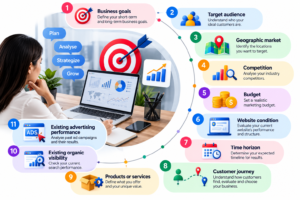
SEO vs PPC Comparison for California Businesses
How a Digital Marketing Agency Can Help
Managing SEO and PPC requires research, implementation, testing, measurement, and ongoing optimisation.
A professional Digital Marketing Agency in California can help businesses evaluate:
- Search demand
- Keyword opportunities
- Competitor activity
- Website performance
- Local search visibility
- PPC opportunities
- Conversion opportunities
- Audience behaviour
- Marketing performance
An agency can also coordinate SEO and PPC so that the two channels support a broader digital marketing strategy.
Why Choose Xtrim Digitech for SEO and PPC?
At Xtrim Digitech, digital marketing strategies can combine SEO, local SEO, Google Ads, content marketing, website development, social media marketing, analytics, and AI-supported marketing solutions. For California businesses, the strategy can be developed around the company’s industry, target audience, geographic market, competition, website, and business objectives.
SEO can support organic visibility and long-term content development, while PPC can provide targeted paid search opportunities. The appropriate combination depends on the business’s requirements and available resources. Our approach focuses on connecting digital marketing activities with measurable objectives rather than evaluating individual channels in isolation.
Key Takeaways: SEO vs PPC for California Businesses
SEO and PPC are two different approaches to search marketing. SEO focuses on improving organic visibility through website optimisation, useful content, technical improvements, local SEO, and other search-related activities. PPC focuses on paid advertising and provides businesses with control over campaign targeting, geographic areas, budgets, keywords, and other advertising settings.
SEO can support long-term organic visibility, while PPC can provide targeted paid traffic when campaigns are active. For California businesses, factors such as competition, location, audience, industry, budget, website condition, and business objectives should be considered before selecting a strategy. Businesses do not necessarily need to choose only one channel. SEO and PPC can work together to support different stages of the customer journey and provide complementary data.
Frequently Asked Questions
Is SEO better than PPC for California businesses?
SEO and PPC serve different purposes. The appropriate strategy depends on the business's goals, budget, competition, audience, geographic market, website, and time horizon.
Is PPC faster than SEO?
Can SEO and PPC be used together?
How much does SEO cost in California?
How much does PPC cost in California?
Which is better for local businesses: SEO or PPC?
How long does SEO take to show results?
Frequently Asked Questions
SEO and PPC serve different purposes. The appropriate strategy depends on the business's goals, budget, competition, audience, geographic market, website, and time horizon.
Conclusion: Building the Right Search Marketing Strategy
SEO and PPC can both play important roles in a California business’s digital marketing strategy, but they operate differently.
SEO focuses on building organic search visibility through useful content, technical optimisation, local search, website improvements, and ongoing search strategy. PPC uses paid advertising to reach users based on campaign targeting, keywords, geographic areas, audiences, and budgets.
The right approach depends on the business’s objectives, competition, target audience, geographic market, available resources, website condition, and expected customer journey.
Businesses that want to build long-term organic visibility may invest significantly in SEO, while businesses that require targeted paid traffic may use PPC campaigns. Many businesses can also combine both approaches to support different marketing objectives.
For California businesses, geographic considerations can be particularly important because markets such as Los Angeles, San Diego, San Francisco, San Jose, Sacramento, and other communities can have different competitive environments and customer behaviour.
Rather than treating SEO and PPC as competing channels, businesses can evaluate how each contributes to measurable outcomes and build a search marketing strategy around their specific requirements.