
Choosing the right digital marketing agency in California is an important decision for businesses that want to improve their online visibility, reach relevant customers, generate leads, and build a stronger digital presence. With agencies offering services such as SEO, Google Ads, social media marketing, content marketing, website development, and analytics, businesses have many options to evaluate.
California has a large and diverse business environment, with companies operating across technology, healthcare, professional services, retail, e-commerce, hospitality, real estate, manufacturing, entertainment, and many other industries. The digital marketing strategy required by a business in Los Angeles may be different from one targeting San Diego, San Francisco, Sacramento, San Jose, or another California market.
The right agency should understand your business model, target audience, industry, service area, competition, website performance, and marketing objectives. Instead of selecting an agency only because of its pricing or service list, businesses should evaluate its strategy, experience, communication, reporting, technical capabilities, and approach to measurable results.
A professional Digital Marketing Agency in California can help businesses coordinate different digital channels into a structured marketing strategy based on their specific requirements.
Why Choosing the Right Digital Marketing Agency in California Matters
Digital marketing includes several channels that can work together to support business growth. SEO can improve organic visibility, Google Ads can reach users searching for relevant services, social media can support audience communication, and content marketing can provide useful information throughout the customer journey.
When these activities are managed without a clear strategy, businesses may find it difficult to determine which channels are contributing to their objectives.
Before choosing an agency, businesses should understand their own requirements.
Important questions include:
- What are the primary business goals?
- Who is the target audience?
- Which locations does the business serve?
- Which products or services require more visibility?
- Is the main objective leads, sales, traffic, awareness, or another measurable outcome?
- What is the current website performance?
- Which digital marketing channels are already being used?
Defining these areas makes it easier to compare agencies based on actual business requirements.

Grow Your Business with Local SEO That Delivers Results
Improve your Google rankings, optimize your Google Business Profile,
attract more local customers, and generate high-quality leads with
Xtrim Digitech's proven digital marketing strategies.

Grow Your Business with Local SEO That Delivers Results
Improve your Google rankings, optimize your Google Business Profile, attract more local customers, and generate high-quality leads with Xtrim Digitech's proven digital marketing strategies.
Define Your Digital Marketing Goals First
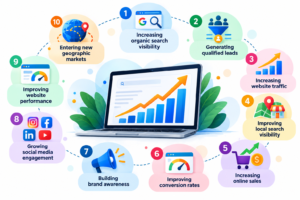
Before contacting agencies, establish what you want digital marketing to accomplish. Different businesses may have very different objectives. A local service company may want more qualified enquiries from a particular California city, while an e-commerce company may focus on online sales, customer acquisition costs, and return on advertising spend.
Common digital marketing objectives include:
- Increasing organic search visibility
- Generating qualified leads
- Increasing website traffic
- Improving local search visibility
- Increasing online sales
- Improving conversion rates
- Building brand awareness
- Growing social media engagement
- Improving website performance
- Entering new geographic markets
Clearly defined goals allow an agency to recommend channels and strategies that are relevant to the business.
Evaluate the Agency’s Digital Marketing Services in California
Digital marketing includes many different services, and businesses do not necessarily need all of them.
A potential agency may provide:
- Search Engine Optimisation
- Local SEO
- Google Business Profile optimisation
- Google Ads
- Social Media Marketing
- Content Marketing
- Website Development
- Technical SEO
- Conversion Rate Optimisation
- Email Marketing
- Analytics and Reporting
- AI Search Optimisation
- Marketing Automation
The right combination depends on the business.
For example, a local restaurant may require local SEO, Google Business Profile optimisation, reviews, and location-focused content. An e-commerce business may require technical SEO, product content, paid advertising, social media, and conversion optimisation. Businesses should therefore evaluate whether an agency’s services actually match their requirements.
Check the Agency’s SEO Experience
SEO is an important component of digital marketing for many businesses.
When comparing agencies, ask how they approach:
- Keyword research
- Search intent
- Technical SEO
- On-page optimisation
- Content optimisation
- Internal linking
- Local SEO
- Structured data
- Website performance
- Search performance analysis
A strong SEO strategy should focus on helping users find useful and relevant information rather than relying on repetitive keyword placement. Businesses targeting California should also consider whether the agency understands geographic search behaviour.
For example, keyword and content requirements for a company targeting Los Angeles may differ from those of a business serving San Diego, San Francisco, Sacramento, or San Jose.
Look for Local SEO Knowledge
Local SEO can be particularly important for businesses that serve customers within specific geographic areas.
When evaluating a Digital Marketing Agency in California, ask whether the agency understands:
- Google Business Profile
- Local keyword research
- Location pages
- Reviews
- Local citations
- Service-area optimisation
- Local content
- NAP consistency
- Internal linking
- Geographic search intent
A local SEO strategy should represent the business’s genuine locations and service areas.
Businesses should avoid creating large numbers of nearly identical location pages that provide little useful information. Each location page should offer relevant information for users in that particular market.
Consider the Agency’s Industry Experience
Different industries have different customer journeys, terminology, competition, and marketing requirements.
For example, the strategy for a California healthcare organisation may differ from that of a technology company, law firm, restaurant, real estate company, manufacturer, or online retailer.
Ask potential agencies whether they have worked with businesses similar to yours.
However, industry experience should be considered alongside the agency’s ability to understand your specific business.
The agency should be able to understand your products or services, customer journey, geographic market, competition, and objectives rather than simply applying a standard industry template.
Review the Agency’s Own Online Presence
A digital marketing agency’s own website can provide useful information about how it communicates its services and expertise.
Consider reviewing:
- Website structure
- Content quality
- Search visibility
- Mobile experience
- Website speed
- Service pages
- Social media activity
- Local presence
- Brand consistency
An agency does not necessarily need to rank first for every keyword to demonstrate marketing expertise because rankings depend on competition, market conditions, resources, and many other factors.
However, its online presence can show how clearly it communicates its capabilities and how effectively it presents information to potential customers.
Ask How the Agency Measures Results
Marketing activities should be connected to measurable objectives.
Depending on the business, useful metrics may include:
- Organic traffic
- Search visibility
- Qualified leads
- Conversion rate
- Cost per lead
- Click-through rate
- Cost per click
- Revenue
- Return on ad spend
- Phone enquiries
- Form submissions
- Engagement
- Local search visibility
The most important metrics depend on the business model.
For example, an online retailer may focus heavily on revenue and return on advertising spend, while a local service company may focus on qualified leads, phone calls, and form enquiries.
Ask the agency how it determines whether marketing activities are contributing to the desired business outcome.
Understand the Agency’s Reporting Process
Reporting should help you understand what has been done and what has changed.
Before hiring an agency, ask:
- How frequently are reports provided?
- Which metrics are included?
- Will the report explain important changes?
- Who will discuss the results?
- How are future activities determined?
- Will the business have access to relevant analytics and advertising accounts?
A useful report should not simply present a large collection of numbers.
It should provide context around performance, completed work, important findings, and planned actions.
Evaluate Communication and Transparency
Communication can significantly affect the agency-client relationship.
Before signing an agreement, understand:
- Who will manage your account?
- How frequently will you receive updates?
- How can you contact the team?
- Who approves content?
- How are strategy changes communicated?
- How are technical issues handled?
- What responsibilities belong to the agency and the client?
A clear process can help prevent misunderstandings and establish realistic expectations.
Ask About the Proposed Digital Marketing Strategy
Businesses should ask potential agencies to explain how they would approach their specific requirements.
A strategy may involve:
Business Research
Understanding the company, services, target audience, competitors, geographic market, and objectives.
Keyword Research
Identifying relevant search terms and understanding the intent behind those searches.
Website Analysis
Reviewing technical SEO, website structure, content, performance, usability, and conversion opportunities.
Content Strategy
Planning useful service pages, blogs, guides, FAQs, location pages, and other content.
Local SEO
Improving visibility for relevant geographic searches where local customers are important.
Paid Advertising
Creating campaigns around relevant searches, audiences, locations, and measurable objectives.
Analytics and Reporting
Tracking meaningful metrics and using performance data to improve the strategy.
The strategy should be customised according to the business rather than copied from another client.
Compare Pricing Based on Deliverables
Pricing is an important consideration, but businesses should not compare agencies only by monthly cost.
Digital marketing pricing can vary based on:
- Number of services
- Website size
- Industry competition
- Geographic targeting
- Advertising budget
- Content requirements
- Technical complexity
- Campaign scope
- Reporting requirements
Two agencies may offer “SEO” at very different prices because their deliverables may be completely different.
When comparing proposals, review exactly what is included.
For example, one proposal may include technical SEO, content creation, local SEO, reporting, and ongoing optimisation, while another may include only basic on-page optimisation.
Comparing deliverables can provide a clearer picture of the actual value of each proposal.
Be Careful With Guaranteed Rankings
Businesses should be cautious about agencies that guarantee specific search rankings or unrealistic business outcomes.
Search visibility can be affected by competition, search demand, website quality, content, technical factors, search engine systems, and actions taken by competing businesses.
A professional agency should explain what it can control and how it will measure progress.
Instead of promising a specific ranking position, agencies should focus on strategy, implementation, testing, measurement, and ongoing optimisation.
Ask About Google Ads Management
If paid search is part of your marketing strategy, ask how the agency manages Google Ads.
Important areas can include:
- Keyword research
- Campaign structure
- Geographic targeting
- Ad copy
- Landing pages
- Conversion tracking
- Negative keywords
- Bid management
- Budget allocation
- Search-term analysis
- Performance reporting
A campaign should be evaluated based on meaningful business outcomes rather than clicks alone.
For a California business, geographic targeting may also be important when campaigns are intended for particular cities, regions, or service areas.
Evaluate Content Marketing Capabilities
Content marketing can support SEO, customer education, brand communication, and search visibility.
An agency may create:
- Blog articles
- Service pages
- Location pages
- FAQs
- Guides
- Case studies
- Social media content
- Video concepts
- Infographics
Content should be accurate, useful, relevant, original, and appropriate for the intended audience.
Ask how the agency researches topics, verifies information, maintains brand consistency, and updates older content.
AI tools can support research and production workflows, but human review remains important for accuracy, originality, context, and strategic relevance.
Check Website Development and Technical Capabilities
A website is often the central destination for SEO, paid advertising, social media, and content marketing.
If the website is slow, difficult to navigate, poorly structured, or not mobile-friendly, marketing performance can be affected.
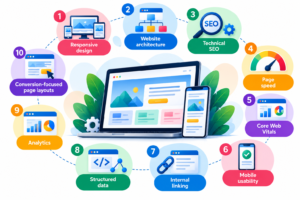
Ask whether the agency can address:
- Responsive design
- Website architecture
- Technical SEO
- Page speed
- Core Web Vitals
- Mobile usability
- Internal linking
- Structured data
- Analytics
- Conversion-focused page layouts
Marketing and website development should ideally work together rather than being treated as completely separate activities.
Consider AI and Emerging Search Technologies
Artificial intelligence is increasingly being incorporated into digital marketing workflows.
AI can support:
- Keyword research
- Search-intent analysis
- Content research
- Audience analysis
- Campaign analysis
- Content ideation
- Reporting
- Marketing automation
- AI search optimisation
Businesses can ask potential agencies how they use AI tools and how human review is incorporated into the process.
AI can help process information and automate suitable tasks, but strategic decisions still require business context, evaluation, and oversight.
Ask About the Agency’s Onboarding Process
A structured onboarding process can help establish a clear foundation for the marketing relationship.
It may include:
- Business discovery
- Account access
- Website audit
- Competitor research
- Audience research
- Keyword research
- Strategy development
- Initial implementation
- Analytics setup
- Ongoing optimisation
Ask what information the agency needs from your business and what will happen during the first stage of the engagement.
Questions to Ask Before Hiring a Digital Marketing Agency
Before selecting an agency, consider asking:
- What services do you recommend for our business?
- Why are those services relevant?
- Have you worked with similar businesses?
- How will you research our audience?
- How will you approach SEO?
- How will you approach local SEO?
- How will Google Ads campaigns be managed?
- How will results be measured?
- What reporting will we receive?
- Who will manage our account?
- How frequently will we communicate?
- What tools do you use?
- How is content reviewed and approved?
- What is included in the monthly fee?
- How will the strategy change based on performance?
The answers can help businesses understand whether an agency’s working model matches their requirements.
Common Mistakes When Choosing a Digital Marketing Agency
Businesses can make several mistakes during the agency selection process.
Choosing Only Based on Price
A lower price may mean a smaller scope of services or fewer resources.
Expecting Immediate SEO Results
SEO performance can vary based on competition, website condition, content quality, technical factors, authority, and search demand.
Focusing Only on Traffic
Traffic can be useful, but relevant traffic and meaningful conversions are often more important than traffic volume alone.
Choosing Without Understanding the Strategy
Businesses should understand what the agency plans to do and why those activities are relevant.
Accepting Unrealistic Guarantees
Guaranteed rankings or guaranteed business results should be treated cautiously.
Ignoring Communication
Clear communication helps businesses understand progress, responsibilities, challenges, and future priorities.
How to Compare Digital Marketing Agencies in California
After creating a shortlist, businesses can compare agencies using consistent factors.
This makes it easier to compare different proposals using similar criteria.
Why California Market Knowledge Can Matter
California contains a wide range of industries, business markets, and metropolitan areas.
A company targeting Los Angeles may face different competitors and customer behaviour from a company targeting San Diego, San Francisco, San Jose, Sacramento, Fresno, or another California market.
This means geographic targeting can influence:
- Keyword research
- Local SEO
- Advertising campaigns
- Landing pages
- Content topics
- Audience targeting
- Competitive research
A Digital Marketing Agency in California should therefore understand both digital marketing fundamentals and the geographic requirements of the business it serves.
At the same time, local knowledge should be supported by technical SEO, content strategy, paid advertising, analytics, and website expertise.
Why Choose Xtrim Digitech for Your Digital Marketing Strategy?
Selecting a digital marketing agency should be based on relevant expertise, transparent processes, communication, strategy, and measurable objectives.
At Xtrim Digitech, our digital marketing services can include SEO, local SEO, Google Business Profile optimisation, Google Ads, social media marketing, content marketing, website development, AI SEO, AI marketing solutions, marketing automation, and analytics.
Our approach begins with understanding the business, target audience, geographic market, search behaviour, website performance, competition, and marketing objectives.
For businesses targeting California customers, the strategy may involve organic search, local SEO, paid advertising, content marketing, website optimisation, social media, analytics, and emerging AI-supported marketing workflows.
The specific combination depends on the business model and its objectives.
A structured approach can help businesses understand how different digital channels contribute to their overall marketing goals.
Frequently Asked Questions
How do I choose a digital marketing agency in California?
Start by defining your business objectives and then compare agencies based on relevant services, SEO capabilities, local market knowledge, reporting, communication, pricing, experience, and strategy.
What should I look for in a digital marketing agency?
How much does digital marketing cost in California?
Should I choose a California-based digital marketing agency?
How long does SEO take to show results?
What questions should I ask before hiring a digital marketing agency?
Frequently Asked Questions
Start by defining your business objectives and then compare agencies based on relevant services, SEO capabilities, local market knowledge, reporting, communication, pricing, experience, and strategy.
Conclusion: Making an Informed Digital Marketing Agency Decision
Choosing a digital marketing agency is an important business decision because the agency’s strategy can influence how a company approaches SEO, local search, paid advertising, content, social media, website performance, and customer acquisition.
California businesses should evaluate agencies based on their actual requirements rather than selecting one only because of price, promises, or a large service list.
The evaluation should include SEO expertise, local search knowledge, Google Ads capabilities, content strategy, website development, analytics, communication, reporting, transparency, and understanding of the target market.
A strong agency relationship should begin with clear objectives and continue through regular measurement, analysis, communication, and optimisation.
For businesses targeting different California markets, geographic relevance should also be considered. Los Angeles, San Diego, San Francisco, San Jose, Sacramento, Fresno, and other markets can have different audiences, industries, competitors, and search behaviour.
By comparing agencies carefully, understanding proposed strategies, reviewing deliverables, and focusing on measurable business objectives, companies can make a more informed decision about their digital marketing partner.
A structured digital marketing strategy can bring together SEO, local search, paid advertising, useful content, social media, website optimisation, analytics, and emerging AI technologies into one coordinated approach.