





The Shift in AI Search Market Share
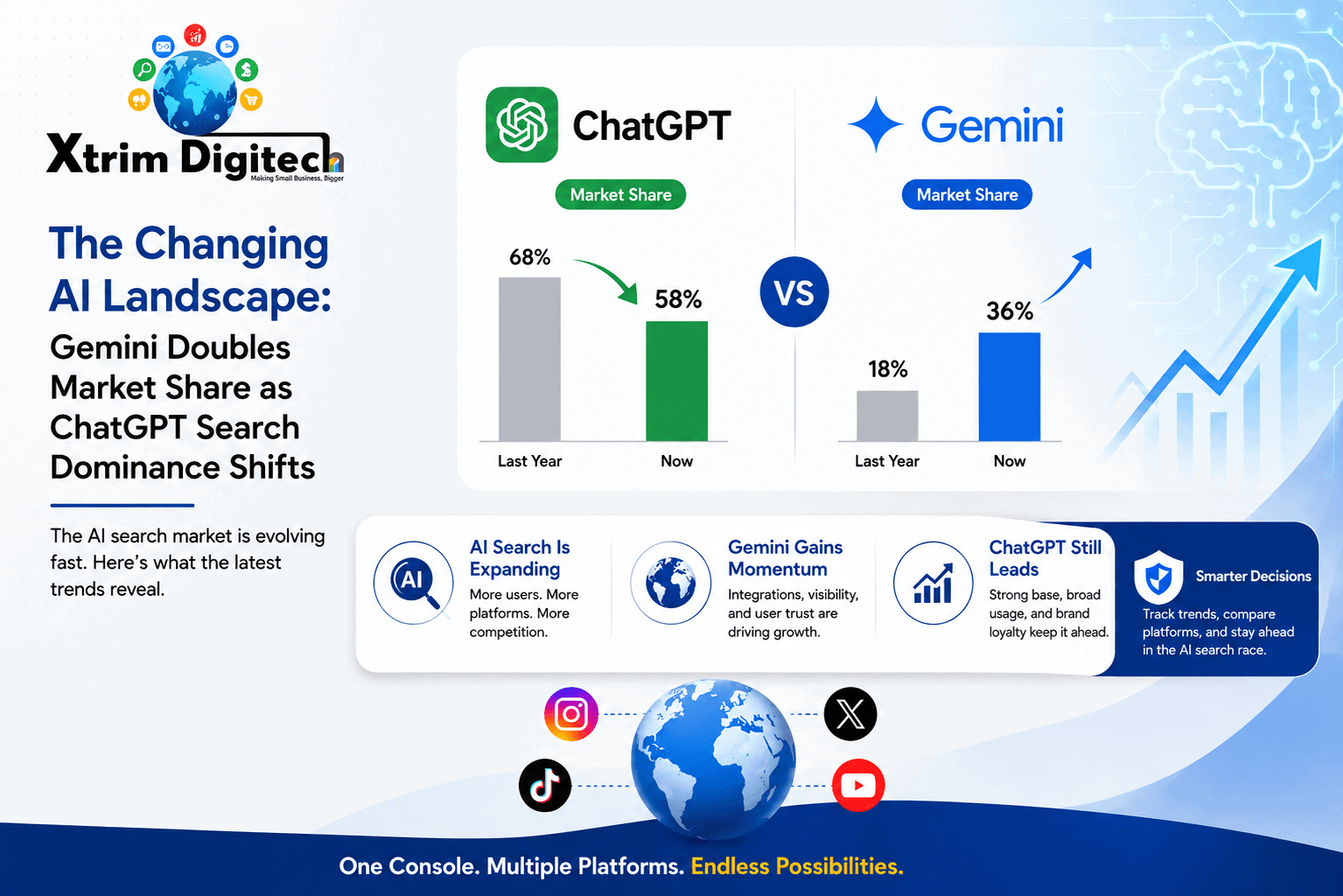
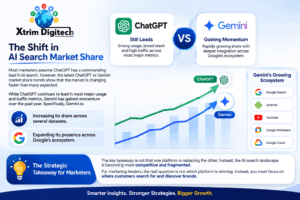
Most marketers assume ChatGPT has a commanding lead in AI search. However, the latest ChatGPT vs Gemini market share trends show that the market is changing faster than many expected.
While ChatGPT continues to lead in most major usage and traffic metrics, Gemini has gained momentum over the past year. Specifically, Gemini is:
- Increasing its share across several datasets.
- Expanding its presence across Google’s ecosystem.
The Strategic Takeaway for Marketers
The key takeaway is not that one platform is replacing the other. Instead, the AI search landscape is becoming more competitive and fragmented.
For marketing leaders, the real question is not which platform is winning. Instead, you must focus on where customers search for and discover brands.
Understanding Google AI Mode: The Future of Interactive Search and SEO
What is Google AI Mode?
Google AI Mode is Google’s conversational search experience that provides direct, comprehensive answers instead of requiring users to browse multiple links. Rather than displaying only traditional search results, it generates responses by combining information from various sources into a single, easy-to-understand answer.
Through this feature, users can also ask follow-up questions, creating a more interactive search experience.
The Shift from Traditional Search Behavior
This development represents a significant shift from traditional search behavior. Instead of reviewing several pages and manually comparing information, users receive synthesized answers directly in the search interface.
Consequently, two major shifts are happening simultaneously:
- Information discovery: The exact way people find information online is changing.
- Brand visibility: The methods brands must use to get noticed are shifting.
The Technology: Powered by Gemini
AI Mode runs on Google’s Gemini models. As of 2026, Gemini 3.5 Flash serves as the default model. This technology allows the system to:
- Understand context deeply across complex queries.
- Weigh multiple sources simultaneously for accuracy.
- Write detailed answers in real-time.
For modern businesses, the important consideration is not the technology behind it, but rather how content is selected and referenced.
Adapting Your Optimization Strategy
Unlike traditional SEO, which focuses primarily on rankings and clicks, success in AI-driven search depends on creating content that is accurate, credible, and directly answers user questions. Google’s systems assess specific criteria before incorporating content into generated responses:
- Quality: The depth and value of the information.
- Relevance: How well it aligns with the user’s intent.
- Trustworthiness: The authority and credibility of the source.

Grow Your Business with Local SEO That Delivers Results
Improve your Google rankings, optimize your Google Business Profile,
attract more local customers, and generate high-quality leads with
Xtrim Digitech's proven digital marketing strategies.
Grow Your Business with Local SEO That Delivers Results
Improve your Google rankings, optimize your Google Business Profile, attract more local customers, and generate high-quality leads with Xtrim Digitech's proven digital marketing strategies.
AI Mode vs. AI Overviews
It is also important to distinguish AI Mode from AI Overviews. While both use generative AI, they serve different user behaviors:
- AI Overviews: Provide quick, snapshot summaries for standard searches.
- AI Mode: Designed for deeper, ongoing conversations that allow users to explore topics through multiple follow-up questions.
As search continues to evolve, businesses must create content that serves both human readers and AI-powered discovery systems.
The Volatility Caveat in AI Metrics
Market-share estimates can vary significantly depending on what researchers choose to measure. Rather than relying on a single data point, marketers must track the broader direction of the trend.
Different industry studies and datasets may focus on distinct touchpoints:
- Web visits: Total desktop and mobile browser traffic.
- Referral traffic: Clicks sent directly from AI platforms to external websites.
- App activity: Daily and monthly active users on dedicated mobile applications.
- Enterprise usage: Corporate and developer API adoption rates.
- Embedded AI experiences: Native tools built directly into browsers and operating systems
Why Gemini Is Growing So Fast: The Power of Distribution
Many people assume the rapid shift to Gemini is driven solely by model quality. While improvements in performance and capabilities certainly play a role, one of the biggest drivers of adoption is distribution.
Simply put, distribution means making a product available where people already spend their time. The easier it is for users to access a tool, the more likely they are to try it and incorporate it into their daily routines.
Google’s Ecosystem Advantage
Google has a unique advantage in this area. Unlike standalone AI platforms that require users to seek them out, Gemini benefits from Google’s vast ecosystem of products and services. This allows Google to introduce AI experiences to users through tools they already use regularly.
Several key factors are contributing to Gemini’s growth:
- Google Search Integration: Google increasingly uses Gemini models to power interactive features like AI Overviews and AI Mode, exposing users to AI-generated answers during everyday searches.
- Android Operating System: Android remains the world’s most widely used mobile operating system, giving Google significant reach across global smartphone markets.
- Google Workspace Utilities: Gemini capabilities are integrated directly into tools like Gmail, Docs, Sheets, and Meet, making AI accessible within existing workflows.
- Unified Google Services: Users can access Gemini through multiple Google products, reducing the need to adopt a completely separate platform.
- Lower Adoption Friction: Familiar interfaces and connected experiences make it easier for users to experiment with AI tools without changing their daily habits.
The Strategic Reality of AI Ecosystems
The key takeaway is that distribution often accelerates adoption. When AI capabilities are embedded into products people already trust and use, engagement can grow quickly. This explains why the shift to Gemini has gained momentum and why its growth remains one of the most closely watched trends in the digital market.
Does This Mean You Should Drop ChatGPT?
The short answer is no. Gemini’s rapid growth does not make ChatGPT irrelevant. In fact, one of the biggest mistakes marketers can make is reacting to market-share headlines by shifting all their attention to a single platform.
Is ChatGPT Losing Market Share?
Several usage and traffic datasets suggest that ChatGPT’s share has declined as competitors such as Gemini continue to gain traction. However, a decline in share does not mean a decline in influence:
- Absolute Growth: ChatGPT’s absolute web visits grew roughly 84% between late 2024 and early 2026.
- Market Expansion: Its share fell only because the overall market grew faster around it.
- Brand Influence: ChatGPT remains one of the most widely used AI platforms and continues to shape how people research products, evaluate solutions, and discover brands.
Is Gemini Bigger Than ChatGPT Now?
Based on the most widely cited usage and traffic measurements available as of mid-2026, the answer is no. Gemini has grown rapidly, supported by Google’s reach across Search, Android, Chrome, and Workspace. Even so, ChatGPT continues to lead many major usage metrics and remains deeply embedded in professional and business workflows.
The Multi-Platform Reality of AI Visibility
These trends highlight that AI visibility is not a winner-take-all game. Brands do not need to choose between ChatGPT and Gemini because different audiences engage with different AI platforms for different reasons:
- B2B Professionals: Many industry professionals use ChatGPT for research, data analysis, content ideation, and problem-solving.
- Consumer Audiences: Regular consumers increasingly encounter Gemini natively through Google’s everyday products and services.
- Fluid User Behavior: Users frequently move between multiple AI tools depending on the specific task they want to complete.
Which AI Should You Optimize For?
For most brands, the answer is more than one. The strongest approach is to build visibility across major AI platforms and then allocate additional effort based on where your target audience spends the most time. Audience behavior, not platform headlines, should guide your optimization strategy.
A Per-Engine Optimization Priority Matrix
One of the most common questions marketers ask today is: Should I prioritize Gemini or ChatGPT for AI search in 2026? The answer depends on your audience, device preferences, and how customers discover information.
Rather than focusing exclusively on one platform, most brands benefit from building visibility across multiple AI engines while allocating additional effort where their audience is most active. Use this matrix to structure your framework:
| AI Engine | Target Audience Fit | Required Optimization Effort | Suggested Priority for Most Brands |
| ChatGPT | Professionals, researchers, knowledge workers, and B2B decision-makers | Medium | High |
| Gemini | Consumer audiences, Android-heavy markets, and Google Workspace users | Medium-High | High |
| Perplexity | Research-focused users looking for cited info and source transparency | Medium | Moderate
|
The Shared Foundation for AI Search Success
Regardless of the platform, visibility depend
s on building core digital signals. To rank across any generated response engine, your digital footprint must maintain:
- Trusted Brand Signals: Verified corporate identities and consistent authority metrics.
- Expert Content: Deep, insightful information that genuinely addresses search intent.
- Strong Topical Authority: Comprehensive coverage of your niche topics.
- Clear Site Architecture: Well-structured technical elements that allow AI bots to crawl data easily.
- Authoritative Brand Mentions: High-quality citations, digital PR, and reviews from trusted third-party sites.
These fundamental pillars support a successful multi-engine Generative Engine Optimization (GEO) strategy and help your brand remain discoverable across all modern AI-powered search experiences.
Engine-Specific Priorities for 2026
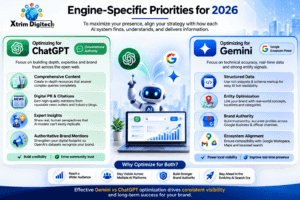
To maximize your presence on each specific platform, your deployment tactics must match how each AI system processes information.
Optimizing for ChatGPT
For ChatGPT, your strategy should lean heavily into building conversational authority and community proof. Focus on:
- Comprehensive Content: In-depth resources that serve as exhaustive answers for complex queries.
- Digital PR and Citations: Securing high-quality mentions across reputable news outlets and industry blogs.
- Expert Insights: Integrating real, human perspectives that AI models cannot easily replicate.
- Authoritative Brand Mentions: Boosting your overall digital footprint so OpenAI’s static datasets recognize your entity
Optimizing for Gemini
For Gemini, your strategy must align closely with Google’s indexing systems and live web integration. Focus on:
- Structured Data: Using rich snippets and schema markup to make data perfectly readable for AI bots.
- Entity Optimization: Linking your brand directly to recognized real-world concepts, locations, and categories.
- Brand Authority: Building highly trustworthy, accurate profiles across Google Business and official channels.
- Ecosystem Alignment: Ensuring compatibility with Google Workspace, maps, and localized search parameters.
Effective Gemini vs ChatGPT optimization requires understanding specific audience behaviors. Ultimate success comes from maintaining consistent visibility across the exact AI platforms that matter most to your customers.
Frequently Asked Questions
Based on the most widely cited usage and traffic measurements available, the answer is no. Most current datasets still show ChatGPT leading overall usage and traffic. However, Gemini has grown substantially and continues to gain share across multiple measurements.